 Rashid Mikidadi
Flagship · EdTech
EduCare LMS + PAL
A multi-tenant learning platform built for schools with low-bandwidth needs, together with PAL, an AI assistant we are developing to read handwritten exams and generate grading and feedback.
Co-Founder & CTO · 2024 – Present · Source repository is private.
YES Accelerator Grand Prize (€4,000), March 2026
An idea and a phone call
Around March 2024, Kananelo first called Chinazom and me about an idea he called EduCare. We had no finished product and nothing figured out. We had an idea, a problem we cared deeply about, and a shared belief that maybe we could build something to help solve it.
We believed that education could completely change the trajectory of someone's life. Yet across many schools, students fall behind while the academic information that could help teachers, administrators, and students understand what is happening stays scattered, hard to access, or simply unused.
That became the question behind EduCare: how can we turn everyday academic data into something schools can actually use to understand their students, see where support is needed, and help every student reach their potential? For us, especially thinking about education across Africa, that was a problem worth trying to solve.
Learning what we didn't know
At the beginning, I thought building a startup was almost straightforward: have an idea, build something, find investors, put it in the market. I was very wrong.
We tried different approaches. We applied to different opportunities. We faced setbacks. Our first version of EduCare was a mobile concept, and the early builds taught me an uncomfortable lesson: something can look like it works and still not really work. We had interfaces, experiments with features, even early ideas about chatbots and AI. Underneath, so much was missing. We were building something that looked like a product without understanding the engineering it takes to make one.
Somewhere along the way we also stopped asking "how do we get people to invest in this?" and started asking a much more important question.
Can we actually build something worth using?
That question changed everything for me.
The restart
When Adoniyas joined the team and we started thinking more deeply about what EduCare could become, Kananelo challenged us to turn the early mobile concept into a full web-based learning management system.
I said yes. The funny thing is, I barely knew what I was saying yes to. At the time I didn't properly understand the difference between a frontend and a backend. APIs, endpoints, databases, testing, system design, deployment: these were words I had heard, not things I understood in practice.
Still, I started building. At some point Adoniyas and I sat down and essentially rebuilt the technical foundation. We set up the repository, started developing the backend, connected the frontend to real functionality, built APIs and endpoints, researched different approaches, tested features, broke things, and fixed them. Slowly, we started understanding what it takes to build a product people can depend on.
Build. Get stuck. Learn. Try again. Break something. Fix it. Keep building.
That became my cycle, and it still is.
EduCare became my classroom
Somewhere during that process, EduCare stopped being just a startup I was working on. It became one of the biggest classrooms I have ever had.
Things I had spent years trying to understand finally made sense because I actually needed them. I learned backend development because EduCare needed a backend. I learned about APIs because we needed APIs. I learned testing because our features needed to work. I started understanding system design because different parts of our application needed to communicate with one another.
Then came deployment, security, GitHub workflows, branches, branch protection, hosting, and debugging: all the things nobody thinks about while an application is still just an idea. I remember setting up Netlify, configuring our backend, working through deployment problems, and trying to understand why something that worked perfectly yesterday suddenly refused to work today.
My coursework and programs, including my AI Engineering coursework with CodePath, helped me learn the fundamentals. EduCare gave me opportunities to apply and deepen that knowledge, and it taught me something no course could: for me, the best way to learn is to build. For years I had treated learning as something to finish before I could start creating. EduCare flipped that. You start building, you hit a problem, you research it, you learn enough to solve it, and you move on to the next one. Slowly, the concepts that once seemed complicated begin to make sense.
Building the real thing: the LMS and PAL
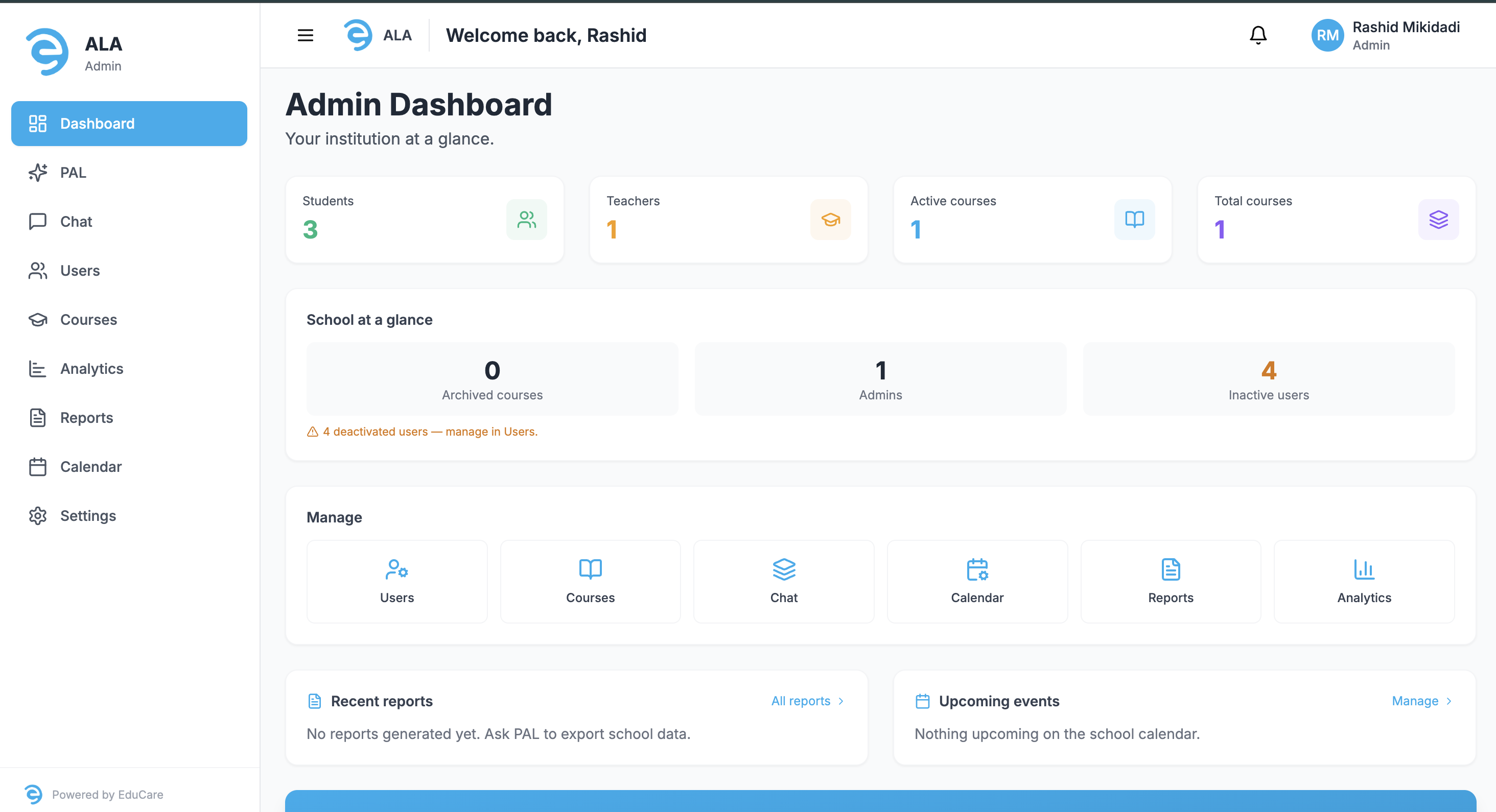
EduCare today is a multi-tenant learning management system: one deployment serves multiple schools, each with its own isolated space, designed around the low-bandwidth realities many schools live with. The web app is built with Next.js and TypeScript and deployed on Netlify. Behind it is a FastAPI backend on Railway, with PostgreSQL and Supabase for data and Redis in the stack.
PAL is the AI engine at the heart of our vision, and we are still actively developing it. We wanted to go beyond managing school information and explore how AI could help teachers with grading, academic insights, and understanding student performance. PAL uses Claude's vision capabilities to read handwritten exam submissions and generate grading and feedback for teachers to review, grounded with retrieval-augmented generation built on Voyage embeddings. That ambition brought a whole new set of things to learn, and by then I was starting to enjoy the process of figuring things out.
How we work matured too. EduCare now runs separate staging and production environments, each with its own deployment and database. We develop and test changes in staging first, check that everything works, and only then release to production. In both environments we use demonstration school accounts to test functionality, so trying out a feature never means touching a real school's or student's private pages. That workflow changed how building feels: releasing a feature became less about hoping and more about checking.
The prize we didn't split
After months of building, I remember sitting down with the team and realizing something that felt almost crazy to say: we actually built it. Not just an idea. Not just a design. Not just a prototype that looked good on our screens. A functional learning management system.
Throughout all of it, Kananelo kept believing we could pull this off, even in moments when we genuinely didn't know how. Chinazom kept the operational side of EduCare moving while Adoniyas and I worked through the technical problems. Different strengths, pushing one vision forward.
Then came a moment I will never forget: EduCare won the YES Accelerator Grand Prize in Germany in March 2026. Seeing Kananelo standing there, representing something that had started as an idea between us, was special.
The €4,000 prize gave us more than recognition. It gave us resources to keep building. And instead of dividing the money among ourselves, we decided to reinvest it into the product. By then, this wasn't about making quick money from an idea anymore. We wanted to see how far we could take it.
Sophia International School: real users, real stakes
After building the product, we ran into a question that was probably even harder: okay, who's actually going to use this thing? Building software is one thing. Convincing someone to trust it, use it, and depend on it is something completely different.
Today, EduCare is being piloted at Sophia International School, and that has changed the way I look at building software all over again.
There is a completely different feeling when something breaks and it isn't just your code anymore. Someone is actually using it.
Sometimes a message comes in about an issue, and I find myself opening my laptop late at night, trying to understand what happened and how to fix it. Features aren't built because they sound cool anymore. We have to think about reliability, security, teachers, students, and school administrators, and about what people actually need. We test carefully, think about how our systems work together, and try to make sure what we build is something people can genuinely depend on.
That is when EduCare became real to me.
Where we are, and where we're going
We haven't made it. Not even close. We're still learning from our pilot, still improving the platform, and still developing PAL. We're exploring opportunities with more schools, building relationships, and thinking seriously about how to take everything we're learning now and scale EduCare much further in 2027.
There is still an incredibly long road ahead: more problems to solve, more things we don't understand, more mistakes, and probably many more late nights. I think that's part of what makes this journey meaningful.
What building EduCare changed in me
Maybe the biggest change hasn't been technical. If you had asked the Rashid of 2024 to build something he had never built before, my first thought would have been: I don't know how to do that. I would have worried about whether I had enough knowledge or the right skills.
Today my first question is different: how can I figure it out?
"I don't know how to do this" no longer means "I can't do this." It means "I need to figure out how."
That mindset has changed how I approach problems far beyond EduCare. I've learned patience, because building something meaningful takes time. I've learned persistence, because not everything works the first time. I've learned that making mistakes doesn't mean you're incapable; sometimes it just means there's something you haven't understood yet.
I couldn't tell this story without the people I've shared it with: Kananelo Buti, Chinazom Onubogu, and Adoniyas Tesfaye. Different countries, different strengths, one problem we believed was worth trying to solve.
Sometimes I look at that original mobile version from 2024, then open the platform we're testing today, and just sit there thinking: how did we get from that to this? The answer isn't a genius idea or a moment where we suddenly knew what we were doing.
We just kept building.
Still early. Still learning. Still building. But this time, it's real.